Positive Reinforcement in ABA: What It Is and How It Helps Kids Learn

Quick answer
Positive reinforcement in ABA means adding something your child values right after a behavior, so that behavior is more likely to happen again. The reinforcer might be praise, a favorite toy, a short activity, or a choice. The BACB ethics code asks behavior analysts to prioritize positive reinforcement procedures, and reinforcers are individualized and faded over time.
Positive reinforcement in ABA means giving your child something they value right after they use a skill, so they are more likely to use that skill again. The “something” might be praise, a high-five, a turn with a favorite toy, a short song, or a choice. It is one of the most common tools in applied behavior analysis (ABA), and it works best when it is matched to your child.
Key takeaways
- A reinforcer is anything that follows a behavior and makes that behavior more likely to happen again.
- Reinforcers are individual. What motivates one child may mean nothing to another.
- Reinforcement is planned and earned. A bribe is offered in the middle of a hard moment to stop it.
- The BACB ethics code asks behavior analysts to prioritize positive reinforcement procedures.
- Good programs fade extra rewards over time so skills hold up in everyday life.
What is positive reinforcement in ABA?
In behavior science, reinforcement is anything that happens after a behavior and makes that behavior more likely in the future. Positive does not mean “nice” here. It means something is added, such as praise or a toy.
The Behavior Analyst Certification Board (BACB) explains that ABA techniques generally involve teaching individuals more effective ways of behaving through positive reinforcement. The National Institute of Child Health and Human Development describes behavior management therapy as an approach that tries to reinforce wanted behaviors and reduce unwanted behaviors.
Here is a simple example. Your child hands you a picture of juice. You smile, say “Juice, you got it!” and pour a cup right away. Asking with the picture worked, so your child is more likely to ask that way again.
Examples of positive reinforcement
Reinforcers usually fall into a few groups. Your child’s team will learn which ones work for your child.
| Type of reinforcer | Examples | When it often helps |
|---|---|---|
| Social | Specific praise, a high-five, a silly face, a cheer | Almost any time; easy to use everywhere |
| Activity | A minute of bubbles, a song, swinging, a short game | Practicing harder skills |
| Tangible | A favorite toy, a sticker, a turn with a fidget | Early learning, or when social praise is not yet motivating |
| Edible | A small bite of a preferred snack | Sometimes early on, with family approval |
| Token | Stars or stickers on a chart that add up to a bigger choice | Older or more experienced learners who can wait |
| Natural | The result of the skill itself, like getting outside after putting on shoes | The long-term goal for most skills |
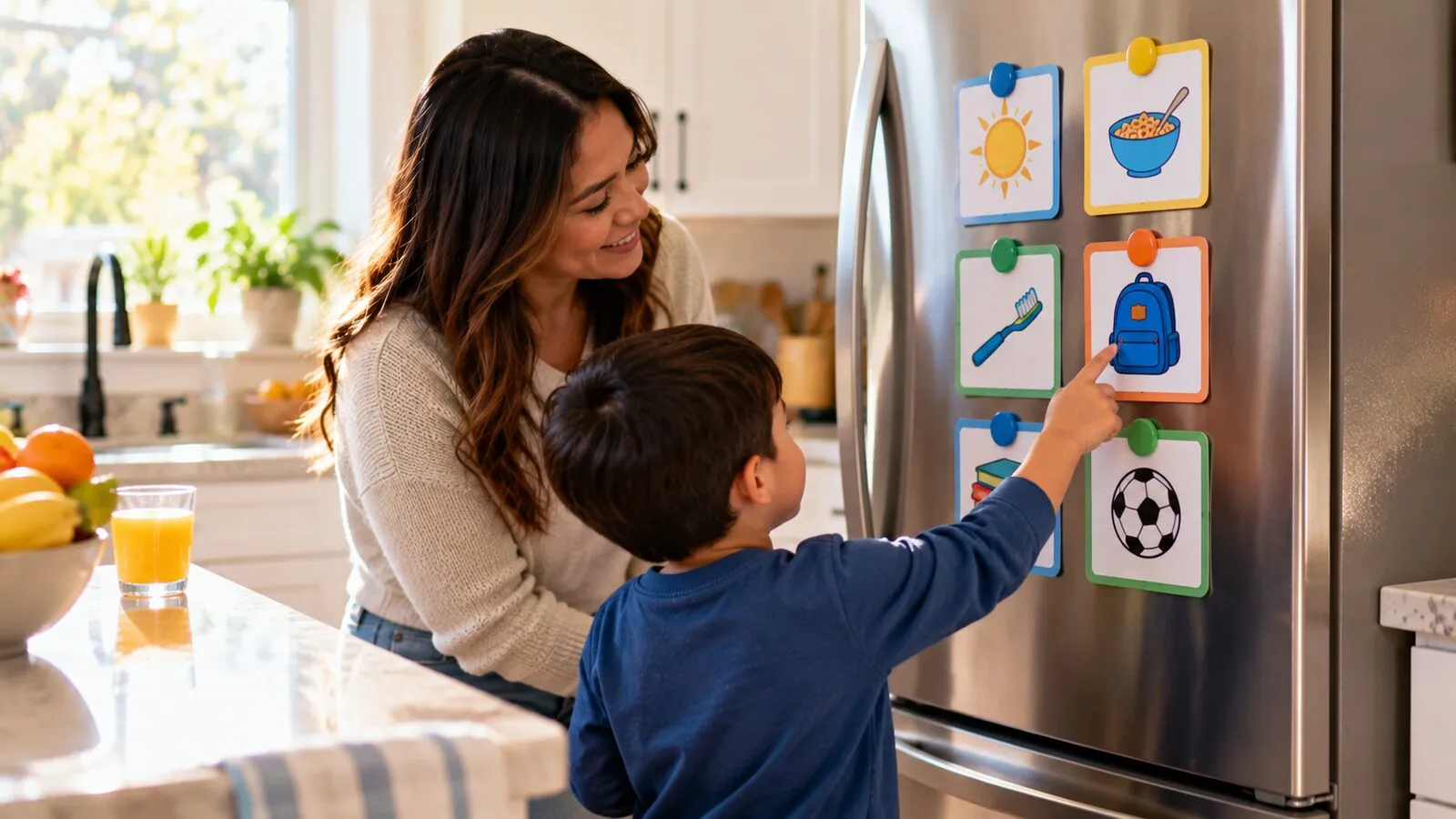
Token systems, like a star chart, let your child earn small symbols that add up to something they chose ahead of time. They can help children practice waiting and connect effort to a reward.
What specific praise sounds like
Praise works better when it names the skill. Compare:
- “Good job!” (general)
- “You asked for help with your words. Nice asking!” (specific)
Specific praise tells your child exactly what they did well.
How ABA therapists find the right reinforcers
What matters is what your child finds motivating, not what adults expect. Some children love trains. Others love watching water pour, hearing a certain song, or bouncing on a ball.
Therapists often use a preference assessment, which is a structured way of offering items or activities and noticing what your child chooses. They also watch during play and ask you what your child enjoys. Preferences change, so teams check again often.
The BACB’s Ethics Code for Behavior Analysts says interventions should prioritize positive reinforcement procedures and be based on assessment results. That means reinforcement should be chosen on purpose, for your child, not handed out at random.
Reinforcement vs bribery
Parents often ask whether reinforcement is just bribery. The difference is timing and planning.
- Reinforcement is planned ahead and comes after the skill. “When you put on your shoes, we can go to the park.”
- A bribe is offered during a hard moment to make it stop. “If you stop crying, I’ll give you candy.”
Bribes can teach a child that a hard behavior leads to a reward. Reinforcement teaches that using a skill leads to good things. Many families use simple first-then language: “First shoes, then park.” You can read more about first-then language and other home strategies in our guide to supporting ABA therapy at home.
Reinforcement vs punishment
These terms can be confusing because they do not mean what they sound like in everyday speech.
| Term | What happens | Effect on the behavior | Example |
|---|---|---|---|
| Positive reinforcement | Something is added | More likely | Praise after your child says “my turn” |
| Negative reinforcement | Something unpleasant is removed | More likely | A noisy toy is turned off after your child signs “stop” |
| Punishment | Something is added or taken away | Less likely | A toy is taken away after hitting |
Modern ABA leans heavily on reinforcement and teaching new skills. The BACB ethics code also says behavior analysts should choose interventions, including consequences, with a focus on minimizing risk of harm. If a hard behavior is happening, a BCBA usually asks what your child is trying to communicate and teaches a safer, easier way to meet that need.
If you have heard concerns about older ABA practices, our article on whether ABA therapy is controversial looks at them honestly.
Reinforcement and your child’s dignity
Reinforcement should never be used to pressure a child who is clearly saying “no.” Many providers pay close attention to assent, meaning your child’s own signals that they are willing to take part. Turning away, crying, or pushing materials away may mean your child needs a break or a different activity.
Good reinforcement makes learning feel safe and enjoyable. It should build on your child’s interests and respect their preferences.
Fading reinforcement over time
At first, a therapist may reinforce a new skill every time it happens. As the skill gets stronger, the team gradually reinforces it less often or switches to more natural rewards. This is called fading or thinning reinforcement.
For example:
- Early on, your child gets a sticker every time they wash their hands.
- Later, they get a sticker after a few handwashes, plus praise each time.
- Eventually, praise and clean hands before snack are enough.
The aim is for skills to last in real life, without a therapist or a reward chart nearby. The CDC notes that in ABA, progress is tracked and measured, so the team can see when it is time to fade. For more on core techniques like prompting and fading, see how ABA therapy works.
Using positive reinforcement at home
You do not need special materials to use reinforcement well. A few simple habits help:
- Catch the good moments. Notice when your child uses a skill and respond right away.
- Be specific. Name what your child did.
- Use what your child loves. A favorite song or game can be more powerful than a toy.
- Keep it quick. Reinforcement works best right after the behavior, not an hour later.
- Stay consistent. Ask your child’s BCBA which skills to reinforce so home and sessions match.
- Avoid rewarding hard behavior by accident. If possible, wait for a calmer moment or a simple ask before giving the item.
With in-home ABA therapy, the therapist can model these strategies in your own kitchen or living room. Our parent training program can also help you practice them with coaching. Your child’s goals, which we explain in ABA therapy goals, will guide which skills you reinforce.
Every child is different, so talk with your pediatrician or a qualified professional about your child’s specific needs.
Talk with our team
If you want to learn how reinforcement could fit your child and your home, we would be glad to help. United Autism Therapy offers ABA therapy across Westminster and Orange County, with a focus on in-home support. Call (714) 709-7819 to schedule a free consultation, or send us a message through our contact page.
Frequently asked questions
Will my child always need rewards to do things?
The goal is usually no. Teams plan from the start to fade extra reinforcers, moving toward praise, natural results, and the satisfaction of doing something well. How quickly that happens varies from child to child.
Is using food as a reinforcer okay?
Sometimes small food items are used, especially early on, but they are only one option. Many teams prefer activities, praise, play, or choices when those work. Talk with your child's BCBA about your family's preferences and any dietary needs.
What if my child does not seem to care about rewards?
That usually means the team has not found the right reinforcer yet. Some children are motivated by unusual things, such as watching a fan spin, hearing a song, or lining up cars. A BCBA can run a preference assessment to learn what your child enjoys right now.
Can reinforcement accidentally make a hard behavior worse?
It can. If a child gets a cookie every time they scream for one, screaming may happen more often. That is why ABA teams look closely at what happens after a behavior and teach an easier way for your child to get the same need met.
References
- About Behavior Analysis — Behavior Analyst Certification Board
- Ethics Codes (Ethics Code for Behavior Analysts) — Behavior Analyst Certification Board
- Treatment and Intervention for Autism Spectrum Disorder — Centers for Disease Control and Prevention
- Behavioral Management Therapy for Autism — Eunice Kennedy Shriver National Institute of Child Health and Human Development
This article is for general education and is not medical advice. Every child is different — please talk with your child’s pediatrician or a qualified professional about your child’s needs. Read our medical disclaimer.