How Does ABA Therapy Work? The Process, Step by Step
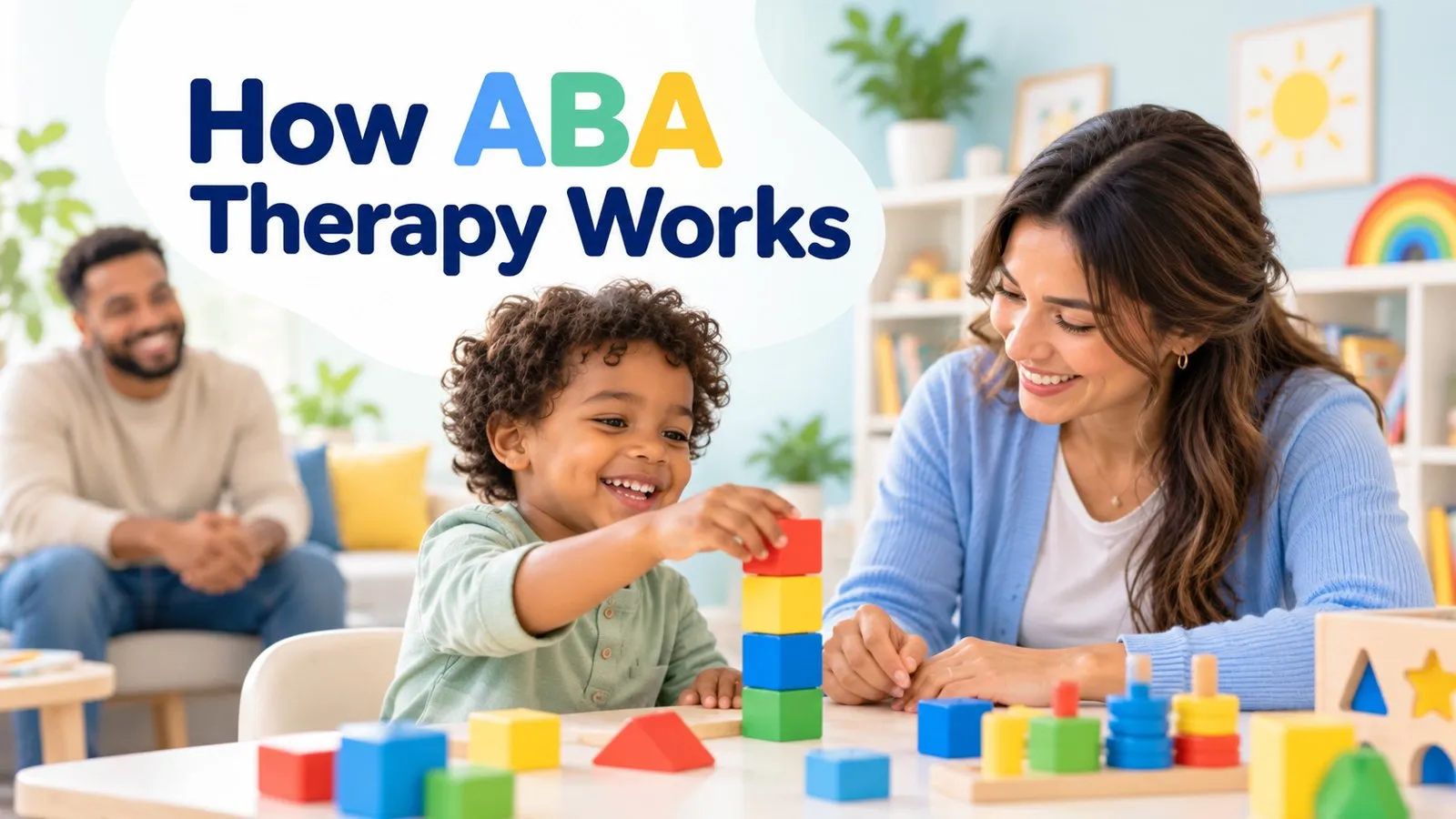
ABA therapy works by finding out what your child can already do, choosing meaningful goals, and teaching those goals in small steps with rewards your child cares about. A Board Certified Behavior Analyst (BCBA) designs the plan, a trained therapist carries it out, and the team tracks data at every session so the plan can change as your child learns.
Key takeaways
- ABA follows a cycle: consultation, assessment, treatment plan, direct sessions, data review, parent training, and reassessment.
- Teaching is built on positive reinforcement and on understanding what happens before and after a behavior.
- Core techniques include prompting and fading, task analysis, discrete trial training, natural environment teaching, and pivotal response training.
- The goal is generalization: skills your child can use with different people, in different places.
If you are new to ABA, our guide to what ABA therapy is covers the basics. This article focuses on the mechanics, from the first phone call to the way a single skill gets taught.
The ABA therapy process, step by step
ABA is not a one-time event. It is a loop that repeats: assess, teach, measure, adjust. Here is how that loop usually runs.
Step 1: Consultation and intake
It starts with a conversation. You share what your child’s days look like, what is going well, and what feels hard. The provider explains their services and what coverage usually requires. For most insurance plans, including Medi-Cal, that means an autism diagnosis and a finding that ABA is medically necessary.
This is also your chance to ask questions and get a feel for the team.
Step 2: Assessment
Before anyone teaches anything, a BCBA gets to know your child. Assessment often includes:
- Caregiver interviews about routines, strengths, interests, and concerns.
- Direct observation of your child playing, communicating, and moving through activities.
- Skills assessments, which are structured ways to look at abilities across areas like communication, play, social skills, self-care, and following directions.
- A functional behavior assessment (FBA) when a behavior is causing harm or getting in the way. An FBA looks for the reason behind a behavior. Is your child trying to get attention, escape a hard task, get a preferred item, or meet a sensory need?
The FBA matters because the same behavior can mean different things. Two children might both throw toys. One is saying “this is too hard.” The other is saying “come play with me.” They need very different plans.
Step 3: The treatment plan
The BCBA then writes an individualized treatment plan. A good plan includes:
- Specific, measurable goals, each tied to something that matters in your child’s life.
- How each goal will be taught.
- How progress will be measured.
- Strategies for any behaviors that interfere with learning or safety.
- Goals for parent training.
You should see this plan, ask questions, and help shape it. If a goal does not fit your family’s values or priorities, say so.
Step 4: Direct therapy sessions
Sessions are where the teaching happens. Often a Registered Behavior Technician (RBT) works with your child. The BCBA, whom the BACB describes as a practitioner who supervises the work of RBTs, oversees and adjusts the program. Sessions may happen in a center, at home, or at school, depending on your child’s needs and the services available.
A session usually mixes structured practice with play, breaks, and everyday routines. For a closer look at what an actual hour looks like, see what happens in an ABA therapy session.
Step 5: Data collection
Throughout each session, the therapist records how your child responds. This might be whether your child answered on their own or needed help, how many times a behavior happened, or how long an activity lasted.
The NICHD describes ABA as an approach that tracks a child’s progress in improving his or her skills. That data is what makes ABA adjustable. When a skill stalls, the BCBA can see it within days, not months.
Step 6: Parent training
You spend far more time with your child than any therapist. Through parent training, a BCBA teaches you the strategies used in sessions and helps you practice them in your own routines, like mealtimes, bath time, or getting out the door.
Parent training is not a test of your parenting. It is a way to make sure your child gets consistent support across the day. Our article on supporting ABA therapy at home has practical ideas.
Step 7: Reassessment and updating the plan
Every so often, the BCBA formally reviews progress, updates goals, and adjusts the plan. Mastered goals are replaced with new ones. Goals that are not moving get a new teaching approach. Insurance plans also typically require updated reports to continue authorizing services.
How often this happens, and how the plan changes over time, is covered in our guide to how long ABA therapy lasts.
Core ABA techniques, explained
The CDC describes behavioral approaches as ones that focus on changing behaviors by understanding what happens before and after the behavior. Here are the tools BCBAs use most often to do that.
Positive reinforcement
Positive reinforcement means following a behavior with something your child values, which makes the behavior more likely to happen again. The BACB notes that ABA techniques generally involve teaching more effective ways of behaving through positive reinforcement.
Reinforcers are personal. They might be praise, a tickle, a favorite song, a turn with a toy, or the chance to take a break. Over time, the goal is to rely more on natural rewards. Saying “juice” gets you juice. Waving to a friend gets a wave back.
The ABC model
ABC stands for antecedent, behavior, consequence. It is a simple way to look at any moment:
| Part | Question it answers | Example |
|---|---|---|
| Antecedent | What happened right before? | Dad says, “Time to turn off the TV.” |
| Behavior | What did your child do? | Your child drops to the floor and screams. |
| Consequence | What happened right after? | The TV stays on for five more minutes. |
Looking at the pattern helps the team change the situation. They might add a two-minute warning and a visual timer (changing the antecedent), teach your child to say “one more minute” (a new behavior), and honor that request when it is used calmly (a new consequence).
Prompting and fading
A prompt is help that makes success more likely. Prompts range from a lot of help to very little:
- Physically guiding a hand (only with the child’s comfort and assent in mind)
- Modeling, or showing the action
- Pointing or gesturing
- A verbal hint
- A visual cue, like a picture
Fading means removing that help step by step, so your child can do the skill on their own. Without fading, children can come to depend on prompts. A well-run program plans for fading from day one.
Task analysis
A task analysis breaks a complex skill into small, ordered steps. Putting on a jacket might become: hold the jacket by the collar, put one arm in, reach behind, put the other arm in, and zip or button.
The team might teach the steps from first to last, or start with the last step so your child gets the satisfaction of finishing. This is called backward chaining.
Discrete trial training (DTT)
The CDC explains that DTT uses step-by-step instructions to teach a desired behavior or response, with lessons broken into their simplest parts. Each “trial” has a clear beginning and end: an instruction, your child’s response, and feedback.
DTT works well for skills that benefit from focused repetition, like learning to match pictures or name objects. In many programs, DTT happens in short bursts mixed with play.
Natural environment teaching (NET)
Natural environment teaching uses everyday moments to practice skills. If your child reaches for bubbles, the therapist might wait for a word, sign, or gesture before blowing them. If your child loves cars, counting might happen while lining them up.
NET follows your child’s motivation, which can make learning feel less like work and more like play.
Pivotal response training (PRT)
PRT is an ABA-based approach that the CDC describes as taking place in a natural setting rather than clinic setting. Instead of teaching skills one by one, it targets a few “pivotal” areas. NICHD gives examples such as motivation and taking initiative to communicate. Improving these can help a child learn many other skills more easily.
In PRT, your child often chooses the activity, and any reasonable attempt is rewarded, not just a perfect answer.
Generalization: making skills stick in real life
A skill is not really learned if your child can only do it with one therapist, in one room, with one set of materials. Generalization means using a skill across people, places, and situations.
BCBAs plan for generalization by:
- Practicing with different people, such as parents, siblings, and teachers.
- Using different materials. A child learning “dog” might see photos, toy dogs, picture books, and the neighbor’s real dog.
- Teaching in different settings, such as home, the park, the grocery store, or the classroom.
- Checking maintenance, meaning whether a skill is still there weeks after it was mastered.
This is one reason parent training and sessions in everyday settings matter so much. United Autism Therapy offers ABA therapy in our Westminster center, in homes, and in schools across Orange County, so teaching can happen where your child actually lives and learns.
What good ABA practice looks like in action
Knowing the techniques helps you spot quality. Signs a program is working the way it should:
- Your child seems engaged and often happy to see their therapist.
- You understand the goals and why they were chosen.
- You can see data or progress summaries, explained in plain language.
- Prompts are being faded over time.
- The team notices when your child is upset or unwilling and adjusts, rather than pushing through.
- Skills are showing up at home or school, not just in sessions.
If something feels off, you can always ask the BCBA to explain. Results vary from child to child, so talk with your child’s BCBA and pediatrician about what progress looks like for your child.
Talk with our team
If you want to see how this process would look for your child, we are glad to walk you through it. Our free consultation is a relaxed chance to ask questions. Call (714) 709-7819 or send us a message to set up a time.
Frequently asked questions
What is a functional behavior assessment?
A functional behavior assessment is a process a BCBA uses to understand why a specific behavior happens. It usually combines interviews with caregivers, direct observation, and data on what happens before and after the behavior. The results guide a plan that teaches a safer or easier way to meet the same need.
Why do ABA therapists take so much data?
Data shows whether a teaching strategy is actually helping. Instead of relying on impressions, your child's BCBA can see if a skill is improving, staying the same, or slipping, and change the plan quickly. You should be able to ask to see this data in a form that makes sense to you.
What is the difference between DTT and natural environment teaching?
Discrete trial training is structured and repeated, often at a table, with a clear instruction, response, and feedback. Natural environment teaching uses everyday moments, like play or snack time, to practice skills where they are actually used. Many programs blend both based on the child and the goal.
Do parents have to be involved in ABA?
Parent involvement is strongly encouraged because it helps skills carry over to daily life. Most programs include parent training where a BCBA shows you strategies and practices them with you. The amount can be adjusted to fit your family's schedule.
References
- Treatment and Intervention for Autism Spectrum Disorder — Centers for Disease Control and Prevention
- Behavioral Management Therapy for Autism — Eunice Kennedy Shriver National Institute of Child Health and Human Development
- About Behavior Analysis — Behavior Analyst Certification Board
- Board Certified Behavior Analyst (BCBA) — Behavior Analyst Certification Board
This article is for general education and is not medical advice. Every child is different — please talk with your child’s pediatrician or a qualified professional about your child’s needs. Read our medical disclaimer.