Daily Living Skills for Children With Autism: A Practical Guide for Parents
Quick answer
Daily living skills for children with autism are the practical self-care and household tasks that build independence, such as dressing, washing hands, brushing teeth, eating with utensils, toileting, and helping clean up. They are usually taught by breaking each task into small steps, using visual supports, and practicing at the times and places the skill is actually needed, often at home.
Daily living skills for children with autism are the practical tasks that help a child take part in everyday life more independently: getting dressed, washing hands, brushing teeth, eating with utensils, using the toilet, and helping around the house. Many autistic children can build these skills when each task is broken into small, clear steps and practiced at the times and places the skill is actually needed.
Key takeaways
- Daily living skills include self-care, hygiene, mealtime, toileting, routines, and simple household jobs.
- Breaking a task into small steps, called a task analysis, makes long routines easier to learn.
- Visual supports, prompting that fades over time, and positive reinforcement are common teaching tools.
- Practicing at home, in real routines, can make it easier for skills to carry over to everyday life.
- The right goals depend on your child’s needs and your family’s priorities, not a fixed checklist.
What are daily living skills?
Daily living skills, sometimes called adaptive skills or self-help skills, are the things we all do to take care of ourselves and our homes. For young children, they usually fall into a few groups:
- Self-care: dressing, undressing, putting on shoes, zipping a jacket.
- Hygiene: washing hands, brushing teeth, bathing, brushing hair, wiping nose.
- Mealtime: sitting for a meal, using a spoon or fork, drinking from a cup, clearing a plate.
- Toileting: recognizing the need to go, using the toilet, washing hands after.
- Routines: following a morning or bedtime routine, getting ready to leave the house.
- Household participation: putting toys away, feeding a pet, helping set the table.
- Choices and self-advocacy: choosing a snack or shirt, asking for help when stuck.
The CDC notes that occupational therapy teaches skills that help a person live as independently as possible, including dressing, eating, bathing, and relating to people. ABA programs often target the same skills, sometimes alongside an occupational therapist.
Why can daily living skills be harder for autistic children?
Every child is different, but a few common reasons come up:
- Many steps in a row. Hand washing alone can have eight or more steps. Remembering the order is hard work.
- Sensory differences. The feel of a toothbrush, the sound of a flushing toilet, or a scratchy tag can make a task uncomfortable. Our article on sensory processing and autism explains more.
- Motor planning. Buttons, zippers, and utensils take fine motor skill and coordination.
- Transitions. Stopping a favorite activity to get dressed can be the hardest part of the routine.
- Communication. If your child cannot yet ask for help, frustration can build quickly.
Knowing the reason behind a struggle helps the team choose the right support. A child who avoids brushing because of a sensory issue needs a different plan than a child who is unsure of the steps.
How is a daily living skill taught step by step?
Task analysis: breaking it into small steps
A task analysis is a list of the small steps that make up a bigger skill. Here is an example for hand washing. Your child’s team would adjust it to fit your sink, soap, and child.
- Turn on the water.
- Wet hands.
- Push the soap pump once.
- Rub hands together (count to 10 or sing a short song).
- Rinse hands.
- Turn off the water.
- Dry hands on the towel.
- Put the towel back.
The therapist records which steps your child does alone and which need help. That data shows exactly where to focus.
Chaining: linking the steps together
Chaining means teaching the steps of a task in order until they connect into one smooth routine. In forward chaining, your child learns the first step, then the first two, and so on. In backward chaining, an adult does most of the task and your child finishes the last step, like pulling up pants or putting the towel back. Backward chaining can work well because your child gets to finish and feel successful right away.
Prompting and fading
A prompt is a hint that helps your child do a step correctly, such as pointing, showing, or gently guiding a hand. The goal is to fade prompts over time so your child relies on them less. A therapist might move from hand-over-hand help to a light touch on the elbow, then to a point, then to nothing.
Visual supports
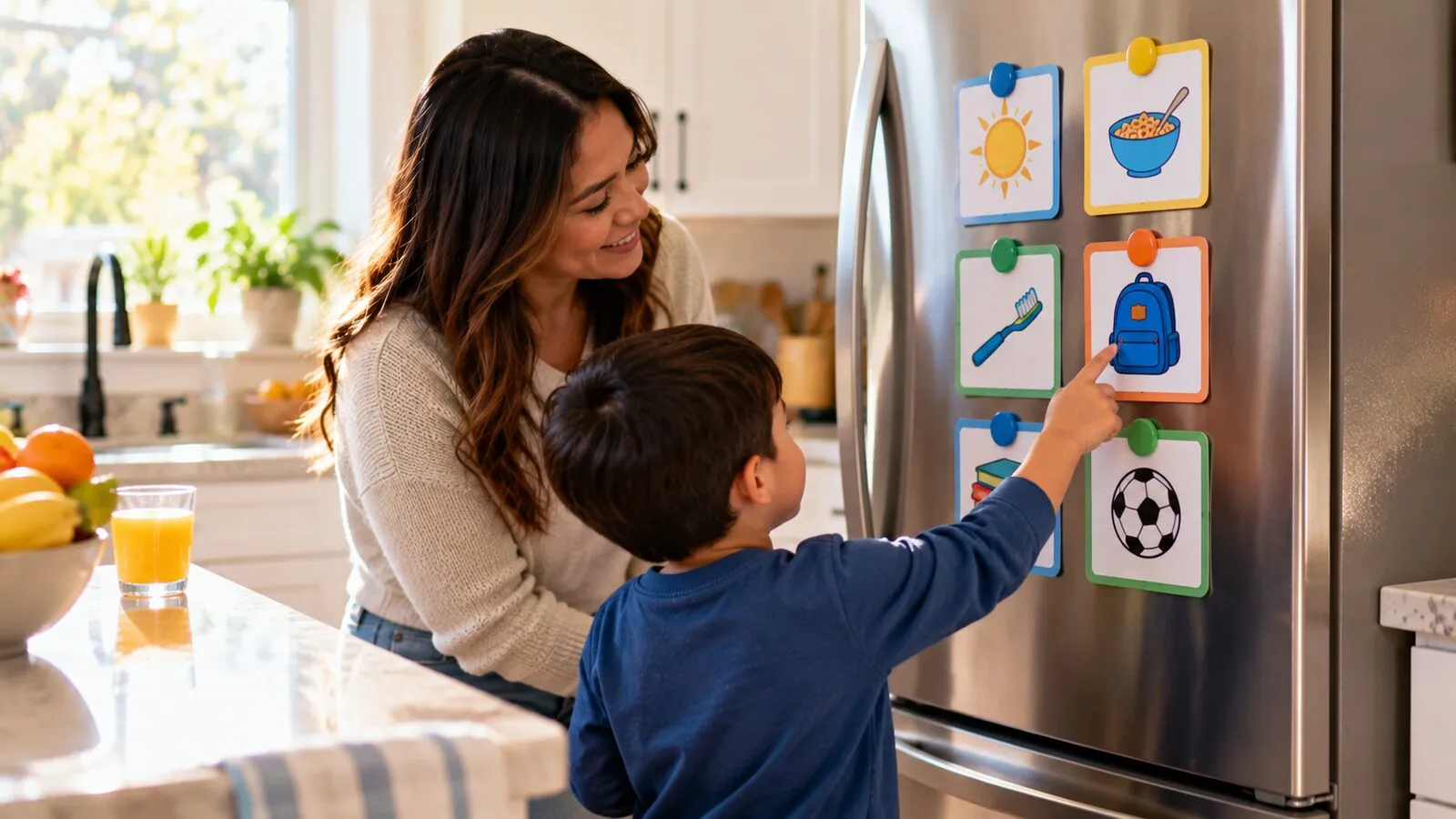
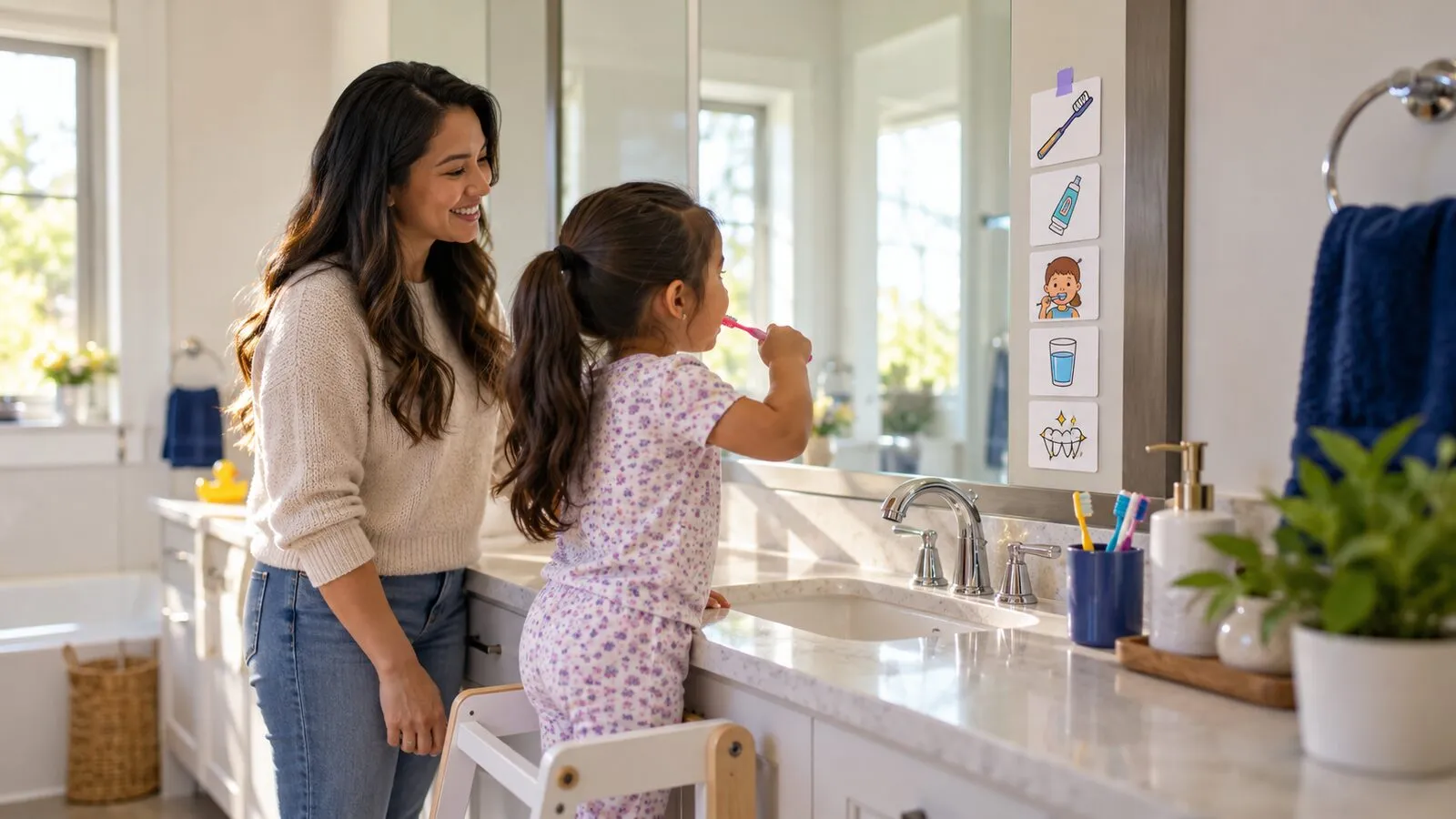
Pictures make steps easier to remember. A picture schedule taped by the sink, a “first, then” card (“First shoes, then park”), or a row of photos on the bedroom door for getting dressed can all help. Visuals also reduce how often a parent needs to repeat directions.
Positive reinforcement
Positive reinforcement means following a behavior with something your child values, so the behavior is more likely to happen again. After brushing teeth, your child might choose the bedtime book. Over time, the natural benefits, like being ready for the park sooner, often take over.
How does in-home ABA help with daily living skills?
Applied behavior analysis (ABA) uses the science of learning to teach meaningful skills. The Behavior Analyst Certification Board describes ABA techniques as teaching more effective ways of behaving through positive reinforcement. A Board Certified Behavior Analyst (BCBA) designs your child’s program, and a Registered Behavior Technician (RBT) often works with your child during sessions.
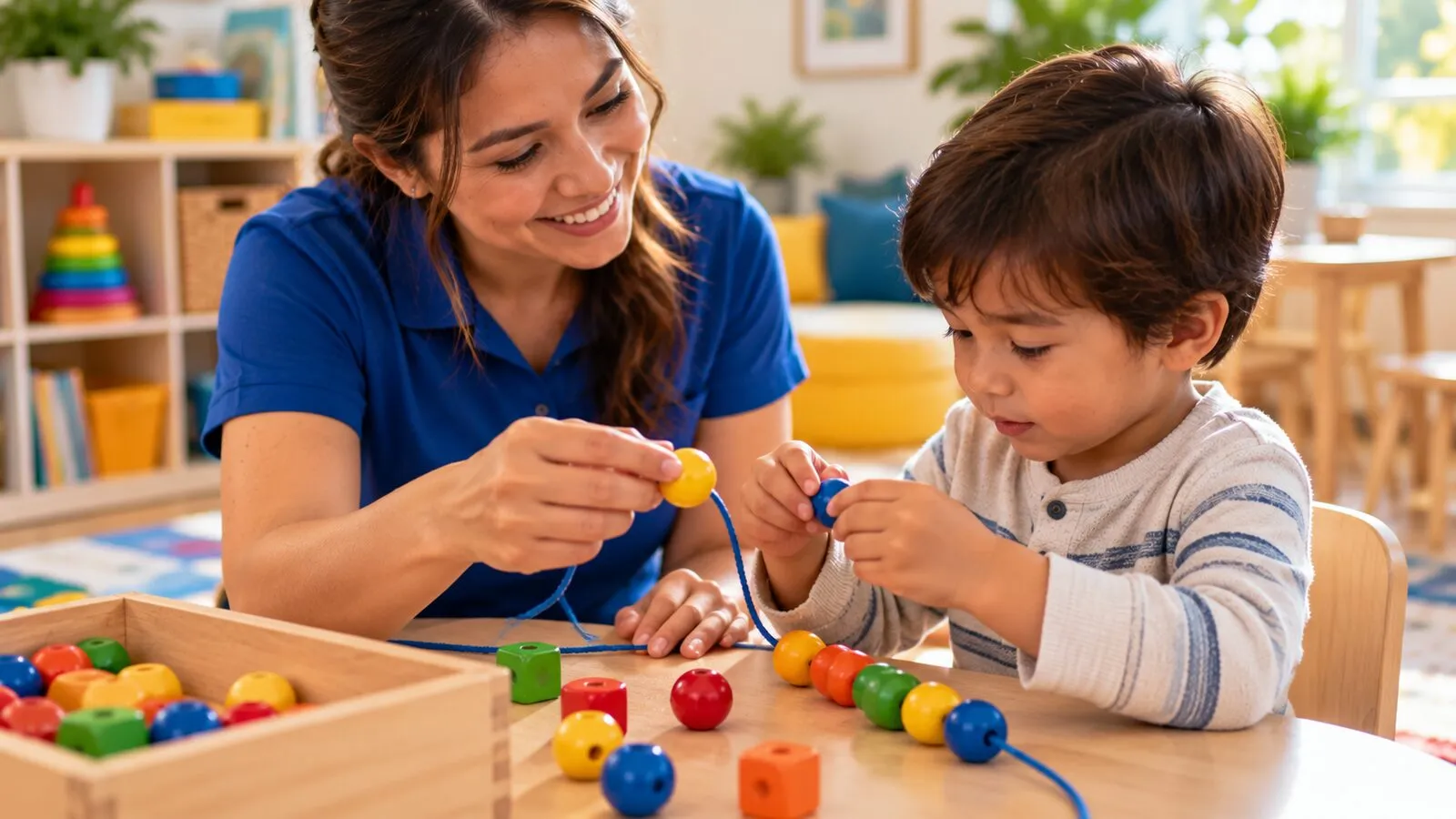
Daily living skills are a natural fit for home-based sessions, because the therapist works in the same place the skill is needed. Your child practices with your toothbrush, your towels, and your morning schedule. That can cut down on the extra step of moving a skill from a clinic to home.
In-home sessions also make it easier to involve parents. A therapist can show you how they prompt a step, then watch you try it and give feedback. That way, practice continues after the session ends. You can learn more about our in-home ABA therapy, or read about how teaching fits into everyday family routines.
The NICHD emphasizes that the most effective therapies are often different for each person, and that treatment should focus on a person’s specific needs. Results vary, and your child’s team should explain how they will measure progress.
Which daily living goals should we start with?
You do not need to work on everything at once. Many families start with one or two routines. Here are some ways to choose:
| Ask yourself | Example |
|---|---|
| Which routine causes the most stress right now? | Getting dressed for school every morning |
| Which skill would give my child more choice or comfort? | Getting a cup of water on their own |
| Which skill is my child already close to doing? | Puts on shoes but needs help with the strap |
| Which skill matters for safety? | Washing hands before eating, staying near an adult in a parking lot |
| Which skill will matter at school or daycare? | Using the toilet, opening a lunch container |
Share these priorities with your child’s BCBA. Goals should be practical, respectful, and connected to your family’s real life. They should be clear enough for you to understand and flexible enough to change when your child’s needs change.
When to bring in other professionals
Some daily living challenges need more than one kind of support. If your child has trouble with fine motor tasks, strong sensory reactions, or a very limited diet, an occupational therapist can help. The NICHD notes that occupational therapy can teach personal care skills such as getting dressed and eating. Read more in occupational therapy for autism.
For eating, sleep, or toileting concerns, talk with your pediatrician or a qualified professional about your child’s specific needs. Some issues have a medical side that should be checked first.
Tips for practicing daily living skills at home
- Pick a calm time to practice. A rushed school morning is not the best moment to teach buttons. Try a weekend.
- Keep supplies in the same place. Predictable setups make steps easier to remember.
- Let your child do the last step. Even if you do most of the task, finishing it builds confidence.
- Offer real choices. “Red shirt or blue shirt?” builds independence and reduces power struggles.
- Make it visual. A few photos taped at your child’s eye level can do a lot of work.
- Give jobs, not just tasks. Feeding the cat or carrying napkins to the table helps your child feel like part of the household.
- Notice effort. Specific praise, like “You turned off the water all by yourself,” tells your child exactly what went well.
The goal is not perfection. It is meaningful progress that fits your child and your family. For more ideas between sessions, see supporting ABA therapy at home.
Talk with our team
If you would like help building daily living skills at home, United Autism Therapy offers BCBA-supervised ABA therapy, including in-home programs across Orange County, with individualized goals and parent coaching built in. We offer a free consultation. Call (714) 709-7819 or contact our team to talk about what would help your child and family most.
Frequently asked questions
What age should my child be able to dress or use the toilet on their own?
There is no single deadline, and autistic children often learn self-care skills on their own timeline. A better question is what your child can do now and what the next small step would be. Your pediatrician can tell you whether anything about your child's development needs a closer look.
Is it better to teach daily living skills at home or at a center?
Both can work, but many self-care skills are easier to learn where they naturally happen. Brushing teeth at your own sink, with your own toothbrush, at the real time of day, removes a step of carryover. Centers can still practice parts of a skill, and many families use both settings.
How long does it take to learn a skill like hand washing?
It varies a lot. Some children learn a short routine in a few weeks; others need months of practice, especially for longer skills like dressing or toileting. Your child's BCBA tracks data on each step so you can see progress, even when it is gradual.
Should I keep doing tasks for my child when we are in a hurry?
That is completely normal, and no family can practice every routine every time. A common approach is to choose one or two routines to practice on calmer days, and help as needed the rest of the time. Your therapy team can help you pick which routines to focus on first.
References
- Treatment and Intervention for Autism Spectrum Disorder — Centers for Disease Control and Prevention
- Occupational Therapy — Eunice Kennedy Shriver National Institute of Child Health and Human Development
- What Are the Treatments for Autism? — Eunice Kennedy Shriver National Institute of Child Health and Human Development
- About Behavior Analysis — Behavior Analyst Certification Board
This article is for general education and is not medical advice. Every child is different — please talk with your child’s pediatrician or a qualified professional about your child’s needs. Read our medical disclaimer.