Social Skills for Children With Autism: What Helps and How ABA Can Support It
Quick answer
Social skills for children with autism are the everyday ways a child connects with others, such as taking turns, joining play, sharing attention, asking for help, and holding a short back-and-forth. They are taught best in small steps, during real play and routines, and around goals that matter to the child and family. ABA, speech therapy, and social skills groups can all support this work.
Social skills for children with autism are the everyday ways a child connects with other people: taking turns, joining play, sharing something interesting, asking for help, and keeping up a short back-and-forth. Many autistic children can learn these skills with the right support, especially when teaching happens in small steps, during real play, and around goals that matter to your child and family.
Key takeaways
- Social skills include play, turn-taking, sharing attention, asking for help, and conversation, not just talking.
- Good goals respect how your child communicates and connects. The aim is not to make your child act like everyone else.
- Skills are easier to use in daily life when they are practiced with real people, like siblings and parents, in real places.
- ABA, speech therapy, and social skills groups can each play a role. Many children benefit from a mix.
- Progress varies from child to child. Small wins, like waiting for a turn, are real progress.
What are social skills, and why can they be harder for autistic children?
Social skills are the behaviors we use to interact with others. Some are simple, like waving hello. Others are complex, like noticing that a friend is upset and responding kindly.
Differences in social communication are one of the core features of autism. The CDC lists signs such as not sharing interests with others by 15 months (for example, showing you a toy they like), not pointing to show something interesting by 18 months, and not noticing when others are hurt or upset by age 2. The American Speech-Language-Hearing Association notes that autistic people may find it hard to have conversations and may not notice social cues, and that eye contact may be uncomfortable.
None of this means your child does not want connection. Many autistic children care deeply about the people around them. They may simply connect in different ways, or need clearer, more predictable chances to practice. For a broader overview, see our guide to autism spectrum disorder in children.
Which social skills do children with autism often work on?
Every child’s goals are different. The table below shows common skill areas and what early goals might look like. These are examples, not a checklist your child needs to complete.
| Skill area | What it means | Example early goal |
|---|---|---|
| Joint attention | Sharing focus on the same thing with another person | Looks or points when a parent says “Look, a dog!” |
| Turn-taking | Waiting, then taking a turn, in a game or activity | Rolls a ball back and forth with a sibling 3 times |
| Play skills | Playing with toys and people in more varied ways | Copies a simple pretend action, like feeding a doll |
| Requesting and protesting | Asking for things and saying “no” or “stop” | Asks a sibling “my turn” instead of grabbing |
| Responding to others | Answering a greeting, name, or simple question | Turns toward a parent when called |
| Conversation | Short back-and-forth exchanges on a topic | Answers one question and asks one back |
| Community skills | Social skills in public places | Waits in line at the library and says “thank you” |
Turn-taking and sharing
Turn-taking is often one of the first social goals because it shows up everywhere: games, slides, conversations, and family meals. Early teaching might use a short, fun game with a clear visual cue, like passing a toy microphone. Sharing usually builds on turn-taking. A child first learns that a turn ends and comes back, which makes giving up a toy feel less risky.
Joining play
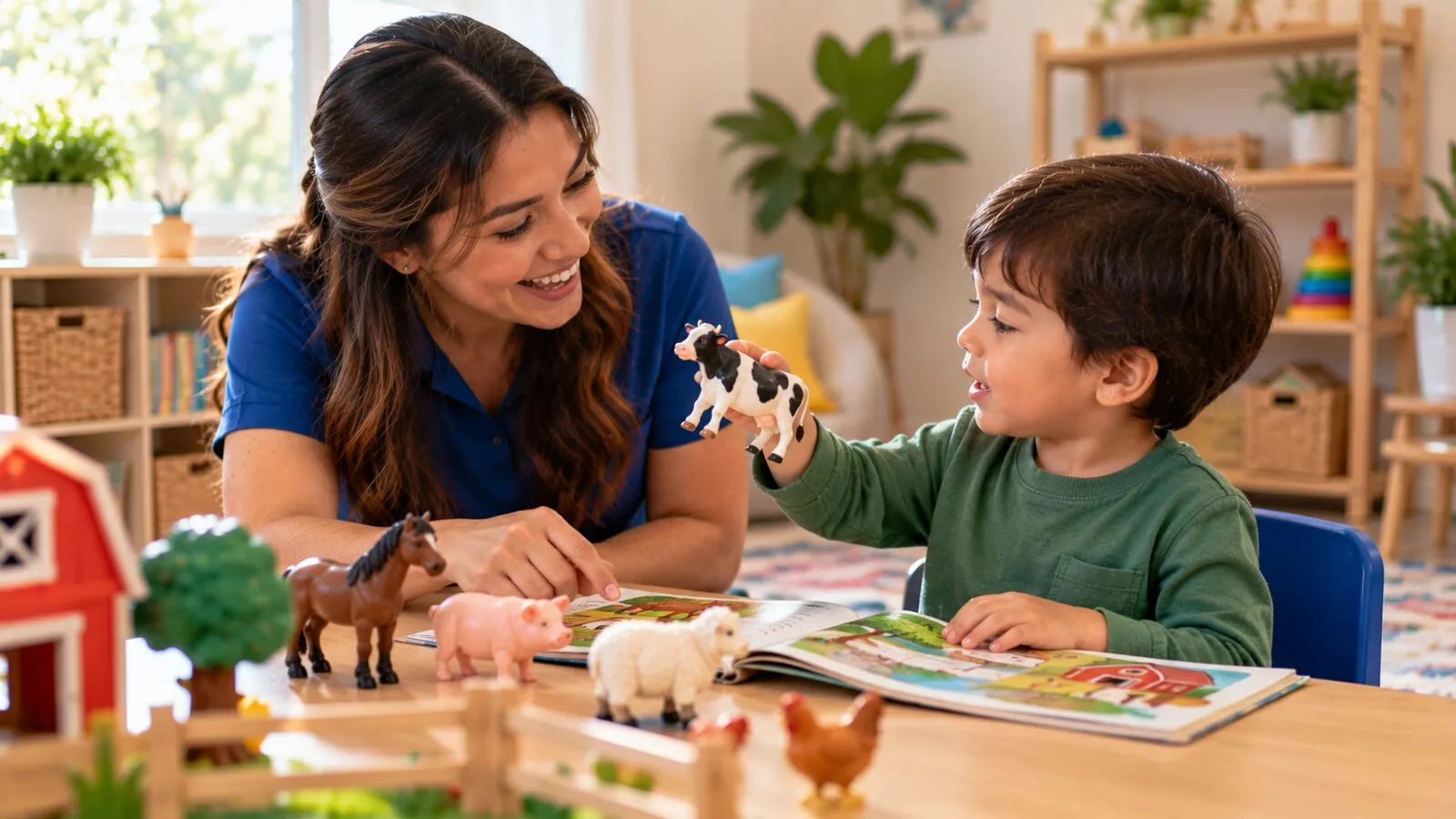
Some children enjoy playing near others but are not sure how to join in. A therapist might teach a simple script (“Can I play?”), practice it with a parent, then try it with a sibling. Play goals often start with your child’s favorite activities, because motivation matters.
Conversation and back-and-forth
For children who speak, conversation goals might include answering a question, asking one back, or staying on a topic for a few turns. For children who use pictures, signs, or a device, the same goals apply through those tools. Communication is much broader than spoken words. Our article on AAC and autism explains how alternative communication supports this.
Saying “no,” asking for help, and self-advocacy
Social skills are not only about pleasing others. Being able to say “stop,” ask for a break, or tell an adult “I need help” protects your child’s comfort and safety. Good programs treat these as important social goals, not as problems to reduce.
How do therapists teach social skills to autistic children?
Several evidence-informed approaches are used, and many teams combine them. The CDC describes behavioral approaches like applied behavior analysis (ABA), which uses principles of learning to build skills, and social-relational approaches such as social skills groups, Social Stories, and DIR/Floortime. The NICHD notes that social skills training teaches children the skills they need to interact with others, often by repeating and reinforcing desired behaviors.
Here are some common teaching tools, in plain language:
- Modeling: The therapist or parent shows the skill first, then your child tries it.
- Prompting: Giving a small hint, like a gesture or the first word, then fading it out as your child gains confidence.
- Positive reinforcement: Following a skill with something your child values, so the skill is more likely to happen again. Often the natural reward works best: your child asks to play, and the game starts.
- Social Stories: Short, simple descriptions of what to expect in a social situation, sometimes with pictures.
- Video modeling: Watching a short video of someone doing a skill, then practicing it.
- Natural environment teaching: Practicing skills during real play and routines instead of only at a table.
Speech-language pathologists also play a big role. ASHA explains that SLPs can help autistic people learn new communication and social skills, sometimes in small groups where children practice together. See speech therapy for autism for more.
How can in-home ABA support social skills?
ABA is the application of the science of learning and behavior. The BACB describes ABA techniques as teaching more effective ways of behaving through positive reinforcement. In ABA, a Board Certified Behavior Analyst (BCBA) designs individualized goals and a Registered Behavior Technician (RBT) often works with your child directly under the BCBA’s supervision.
When ABA happens at home, social goals can be practiced with the people your child sees every day. That makes a difference. A skill learned only with a therapist may not carry over to a brother, a cousin, or a neighbor. At home, the team can:
- Practice turn-taking with a sibling during a real game, not a pretend one.
- Coach a parent to set up small chances for your child to ask, share, or respond.
- Work on greetings when a family member walks in the door.
- Prepare for a community outing, like a birthday party or a store visit, with short practice runs.
Learn more about how our in-home ABA therapy works and how families take part.
An example of a respectful social goal
Here is an illustrative example, not a real child. A five-year-old loves trains and plays with them alone for long stretches. His parents would like him to play with his younger sister sometimes.
A respectful goal would not be “stop playing alone.” It might be: “During train play, he will offer his sister a train or accept a train from her, 3 times per session, with no more than a gesture prompt.” The activity stays his favorite. The goal adds a small, meaningful moment of connection. If he shows he needs a break from his sister, he can ask for one, and that is respected.
What makes a social skills goal meaningful?
The best social goals are chosen with your family, not imposed. Before agreeing to a goal, it is fair to ask:
- Does this matter in my child’s real life? Joining recess games may matter more than memorizing small talk.
- Does it respect who my child is? Goals should not require your child to hide harmless behaviors like stimming, or to force eye contact.
- Is it the right size? A good goal is one step beyond what your child does now.
- Will my child use it with more than one person? Skills should eventually work with family, peers, and new people.
- Does my child seem willing? Watch for signs of comfort and engagement. A good team pays attention to your child’s assent, meaning their signs of willingness to take part.
You can read more about how goals are chosen and measured in our guide to ABA therapy goals.
How can parents practice social skills at home?
You do not need special materials. Small, playful moments add up.
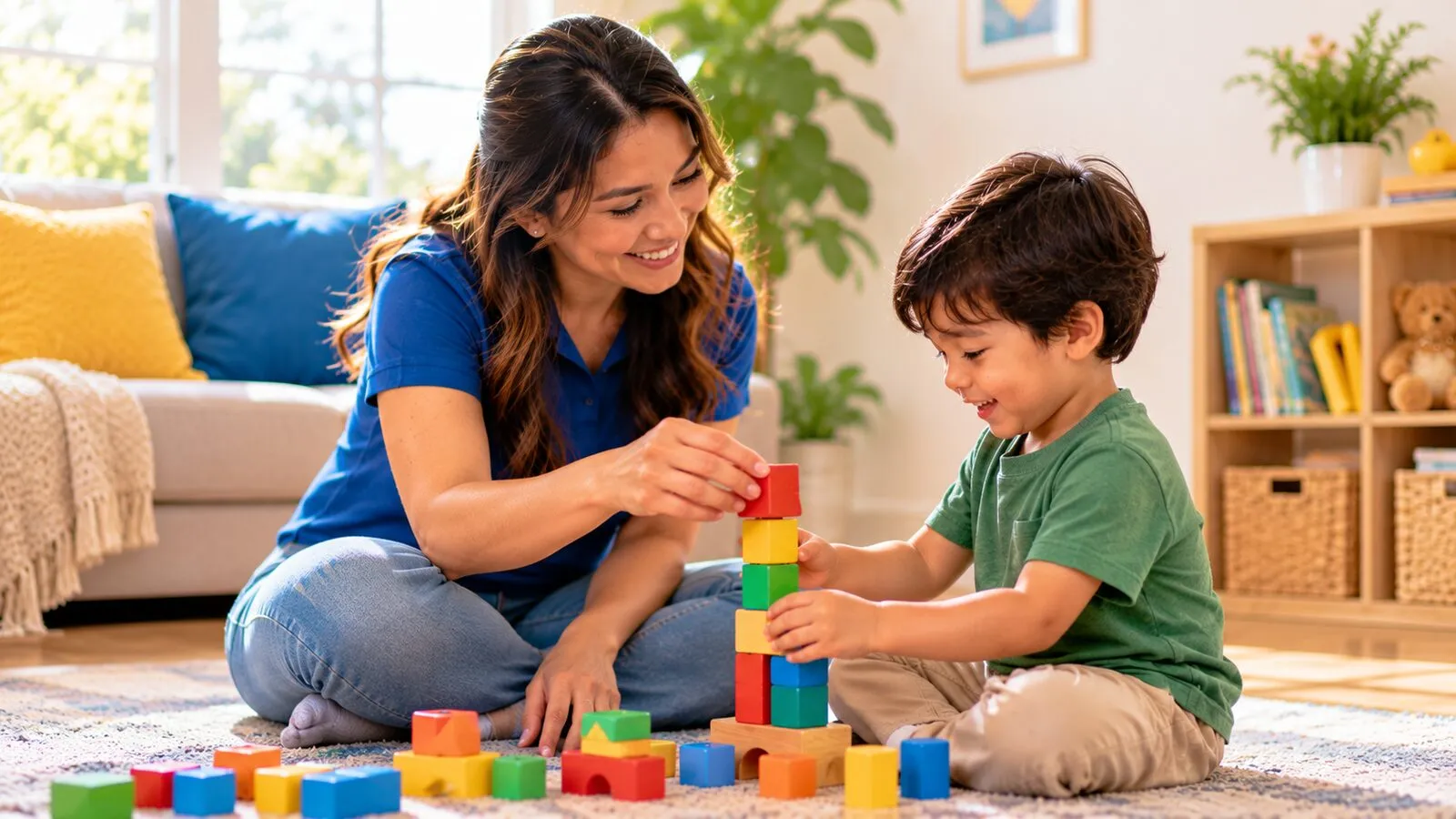
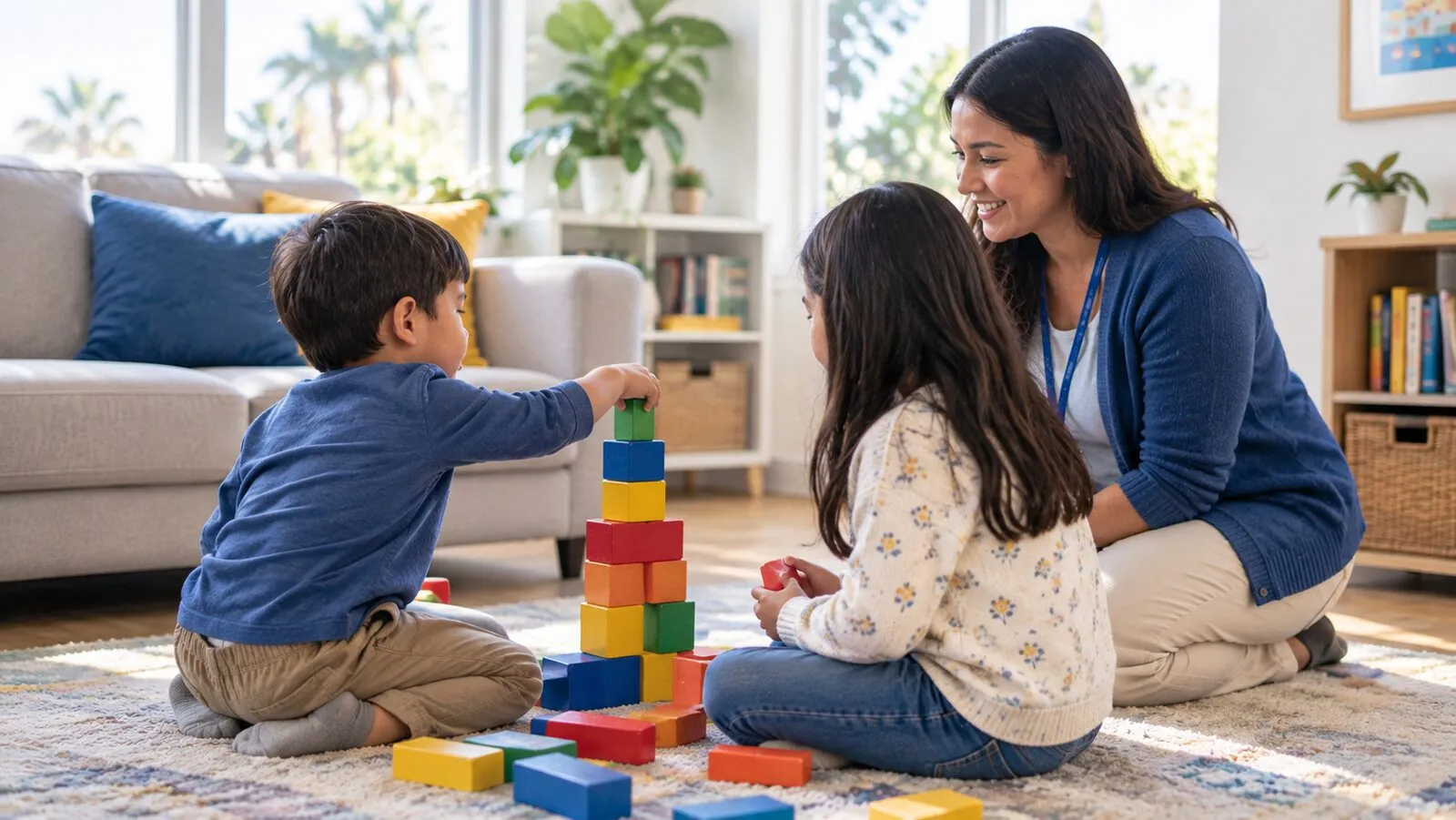
- Play short turn-taking games. Rolling a ball, stacking blocks, or a simple board game. Say “my turn” and “your turn” out loud.
- Pause and wait. Before helping, wait a few seconds. This gives your child a chance to ask, point, or look to you.
- Join your child’s interests. If your child loves dinosaurs, play dinosaurs. Shared interests make connection easier.
- Narrate feelings simply. “Grandma is smiling. She is happy you said hi.”
- Practice before new situations. Act out a playdate or a trip to the park at home first.
- Celebrate small wins. A shared smile or one turn in a game is progress.
For more strategies between sessions, see supporting ABA therapy at home. If you have questions about your child’s development or communication, talk with your pediatrician or a qualified professional about your child’s specific needs.
Talk with our team
If you would like support with social skills for your child, United Autism Therapy offers individualized ABA therapy with in-home programs across Orange County. Our BCBA-supervised team can talk with you about your child’s strengths and the social goals that matter to your family. We offer a free consultation. Call (714) 709-7819 or contact our team to set up a time to talk.
Frequently asked questions
At what age can social skills support start?
Social learning starts very early, so support can begin as soon as a family has concerns, often in the toddler and preschool years. For young children, social goals usually look like play: back-and-forth games, pointing to share something fun, or responding to a name. Your child's pediatrician or care team can help you decide when to start.
Should my autistic child be taught to make eye contact?
Not as a forced rule. Eye contact can be uncomfortable for many autistic people, and a child can show they are listening in other ways, such as turning toward the speaker or answering. Many teams focus on the purpose behind the skill, like noticing when someone is talking to you, rather than on eye contact itself.
What is the difference between a social skills group and ABA for social skills?
A social skills group brings several children together to practice in a structured setting, often led by a therapist or educator. ABA for social skills is usually individualized: a BCBA picks specific goals for your child, teaches them step by step, and tracks data on progress. Some children benefit from both, and a group can be a good place to practice skills learned one-on-one.
My child prefers to play alone. Is that a problem?
Not necessarily. Enjoying solo play is fine, and social goals should never aim to take away a child's interests or downtime. The question is whether your child has the skills to connect when they want to, such as joining a game, asking a sibling for a turn, or telling someone to stop. Those are the skills a team can help build.
References
- Signs and Symptoms of Autism Spectrum Disorder — Centers for Disease Control and Prevention
- Treatment and Intervention for Autism Spectrum Disorder — Centers for Disease Control and Prevention
- Social Skills Training — Eunice Kennedy Shriver National Institute of Child Health and Human Development
- Autism — American Speech-Language-Hearing Association
- About Behavior Analysis — Behavior Analyst Certification Board
This article is for general education and is not medical advice. Every child is different — please talk with your child’s pediatrician or a qualified professional about your child’s needs. Read our medical disclaimer.