
Autism and Sleep Routines: How to Build Calmer Nights at Home
Quick answer
Sleep problems are common in autistic children. Experts recommend checking first for medical causes, then building a calm, predictable bedtime routine: the same steps in the same order, a visual schedule, a consistent wake time, and a sleep space that suits your child's senses. If sleep stays hard after a few consistent weeks, talk with your pediatrician before trying supplements like melatonin.
Many autistic children have a hard time falling asleep, staying asleep, or waking far too early. The CDC lists unusual sleeping habits among the characteristics some autistic people have. The good news is that a calm, predictable bedtime routine helps many families. This guide covers why sleep can be hard, how to build a routine step by step, and when Orange County parents should bring in their pediatrician.
Key takeaways
- Sleep problems are common in autistic children, and they affect the whole family.
- Rule out medical causes first: pain, reflux, constipation, allergies, snoring, or medication side effects.
- A predictable routine, with the same steps in the same order every night, is the foundation.
- Visual schedules, a consistent wake time, and a sensory-friendly bedroom often help.
- Talk with your pediatrician before trying melatonin or any other supplement.
Why is sleep often hard for autistic children?
There is rarely one single cause. Several things can stack up at once:
- Sensory differences. Light, noise, the feel of pajamas or sheets, or the temperature of the room may bother your child more than they bother you. Our guide to sensory processing and autism explains this in more detail.
- Difficulty with transitions. Moving from a favorite activity to bedtime is a big transition. If your child finds changes hard during the day, bedtime may be the hardest change of all.
- Communication differences. A child who can’t easily say “I’m scared,” “my tummy hurts,” or “I’m not tired yet” may show it through crying, getting up again and again, or refusing bed.
- Medical and co-occurring conditions. Things like reflux, constipation, allergies, seizures, sleep apnea, or anxiety can disrupt sleep. Some medications can affect sleep, too.
- Irregular schedules. Late weekend nights, long naps, or screens close to bedtime can shift your child’s body clock.
Because so many factors can be involved, a 2020 practice guideline from the American Academy of Neurology recommends that clinicians look for coexisting medical conditions and medications that could be contributing before starting sleep treatment.
How much sleep does my child need?
Autistic children need the same amount of sleep as other children their age. The American Academy of Sleep Medicine recommends, per 24 hours:
| Age | Recommended sleep |
|---|---|
| 1–2 years | 11–14 hours (including naps) |
| 3–5 years | 10–13 hours (including naps) |
| 6–12 years | 9–12 hours |
| 13–18 years | 8–10 hours |
These are ranges, not targets to force. If your child is regularly well below the range, often groggy, or very irritable during the day, mention it at your next pediatric visit.
What does a good bedtime routine look like?
The 2020 guideline recommends behavioral strategies as the first step for sleep problems in autistic children. In everyday terms, that mostly means a routine your child can predict.
A strong bedtime routine is:
- Short. About 20–30 minutes from start to lights out works for many families.
- The same every night. Same steps, same order, same place, as much as your family’s life allows.
- Calming. Steps get quieter and dimmer as bedtime gets closer.
- Ends in bed. The last step happens in the bedroom, so bed becomes the “finish line.”
Sample routine:
- Last snack and a drink of water
- Bath or washcloth wash
- Pajamas on
- Brush teeth and use the toilet
- Choose one book
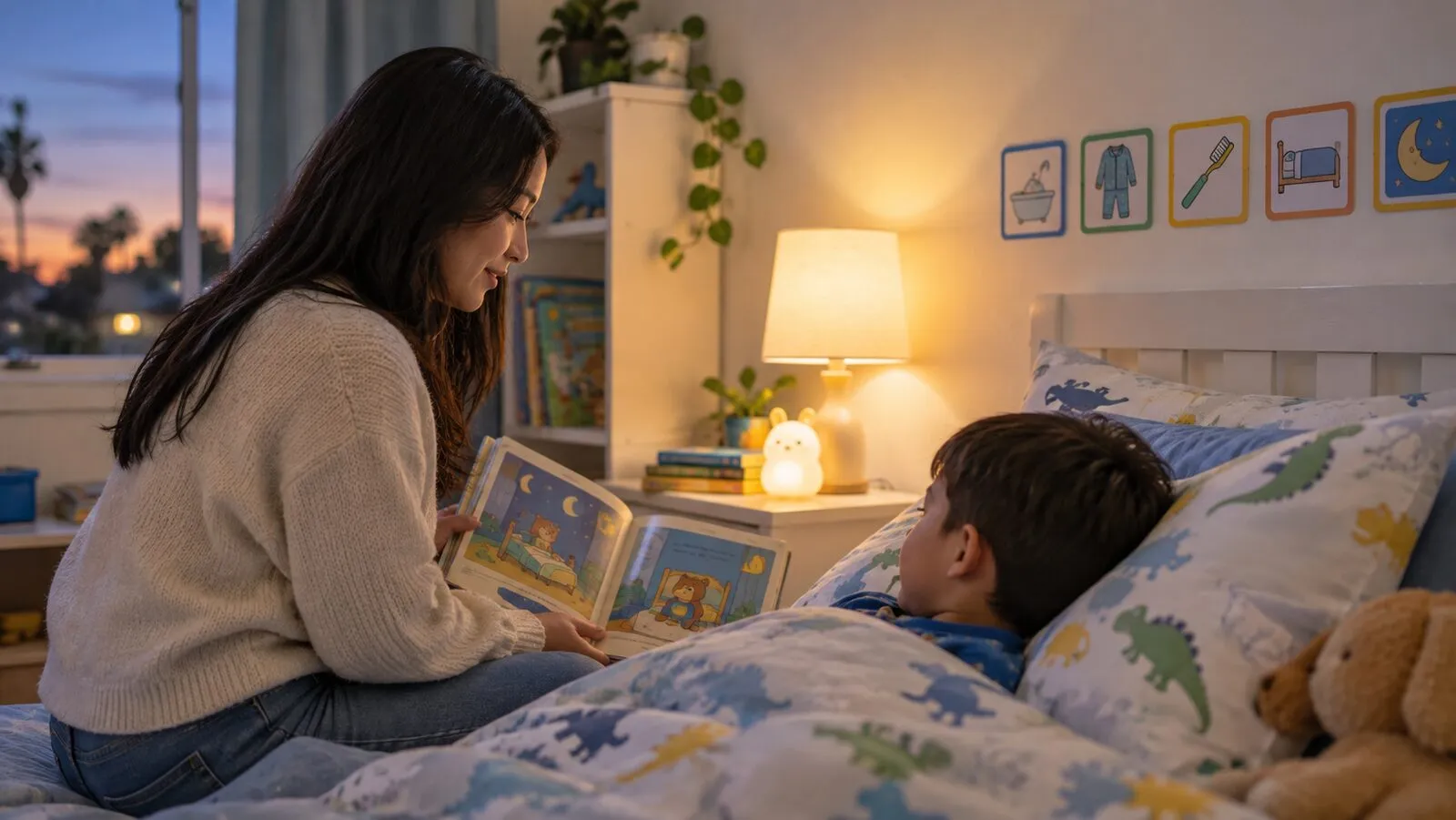
- Read together in bed with the lamp on low
- Lights out, with the same short goodnight phrase every night
You don’t have to use these steps. Pick ones that fit your child and your home, then keep them steady.
How can a visual schedule help at bedtime?
Many autistic children understand pictures more easily than spoken directions, especially when they are tired. A visual bedtime schedule shows each step as a picture or photo, in order.
How to make one:
- Take photos of your child doing each step, or use simple drawings or picture cards.
- Put them in a row on a strip of paper or a board near the bathroom or bedroom.
- Let your child move or flip each card when a step is done.
- Keep the last card as “bed” or “sleep,” so your child can see the end coming.
A “first, then” card can help with tough steps: “First brush teeth, then choose a book.” Read more about using routines as learning moments in ABA in everyday family routines.
How can I make the bedroom more sleep-friendly?
Think about the room from your child’s senses:
- Light: Dim lights in the hour before bed. If summer evenings stay bright, blackout curtains can help. A soft night light is fine if your child prefers it.
- Sound: Some children sleep better with steady background sound, like a fan. Others need quiet. Watch what your child seems to prefer.
- Touch: Notice tags, seams, and fabrics. Some children prefer snug pajamas; others want loose ones.
- Temperature: Keep the room comfortable. Warm Southern California nights can make a stuffy room hard to sleep in.
- Screens: Try to end screen time a while before bed and keep devices out of the bedroom at night.
The AAN guideline reviewed weighted blankets and found they did not appear to improve sleep in the research it looked at. If your child enjoys one, ask your pediatrician or occupational therapist whether it is safe and appropriate.
What about melatonin?
Melatonin is easy to buy, so many parents wonder about it. A few things to know:
- In the U.S., melatonin is sold as a dietary supplement. NCCIH notes that supplements are not regulated the way medicines are, and the amount in a product may not match the label.
- The AAN guideline suggests that melatonin can be considered if behavioral strategies have not worked, and only with a clinician’s guidance.
So the order is: check for medical causes, build and keep a routine for a few weeks, and then talk with your pediatrician about whether anything else makes sense. Don’t start melatonin or any other sleep aid without that conversation.
What if my child wakes up at night?
Night waking is common. A few steps can help:
- Make safety the first priority. Some children wake and wander. Secure doors and windows, remove hazards from the bedroom, and consider a door chime or alarm.
- Keep night responses boring. Use low light, few words, and the same calm phrase. Avoid turning on screens or starting play.
- Return to bed the same way each time. Consistency helps your child learn what happens when they wake.
- Keep a short sleep log. Note bedtime, how long it took to fall asleep, night wakings, and wake time for one or two weeks. It’s very useful for your pediatrician.
How can ABA support bedtime routines?
When bedtime is part of your child’s treatment plan, a Board Certified Behavior Analyst (BCBA) can help in practical ways:
- Break the routine into small, teachable steps (a task analysis).
- Build a visual schedule that matches your child’s communication level.
- Teach skills that make bedtime smoother, like toothbrushing, changing into pajamas, or asking for help.
- Coach parents, so everyone uses the same steps and words every night.
In-home ABA is well suited to this, because the therapist works in the same home where bedtime actually happens. Our guide to daily living skills and autism covers related routines like dressing and hygiene.
ABA does not replace medical care. If your child’s sleep problems may have a medical cause, that comes first. Every child is different, and results vary.
Where can Orange County parents get help?
- Your pediatrician. The first stop for sleep problems. Bring your sleep log, and ask whether a referral to a sleep specialist makes sense.
- The Regional Center of Orange County (RCOC). RCOC coordinates services and supports for eligible people with developmental disabilities and their families. See our Orange County autism resource guide for how intake works.
- Your child’s therapy team. If your child already receives ABA, speech, or occupational therapy, tell the team about sleep. Tiredness affects learning and behavior during the day, too.
Next steps
Pick one change to start this week: a fixed wake time, a simple picture schedule, or dimmer lights an hour before bed. Keep it steady for two to three weeks before judging whether it works.
If you’d like help building routines at home, United Autism Therapy provides in-home ABA across Orange, Riverside, San Diego, San Bernardino and Santa Clara Counties. Contact us for a free consultation or call (714) 709-7819.
Frequently asked questions
How much sleep does my autistic child need?
Autistic children need the same amount of sleep as other children their age. The American Academy of Sleep Medicine recommends about 11–14 hours (including naps) for ages 1–2, 10–13 hours for ages 3–5, 9–12 hours for ages 6–12, and 8–10 hours for teens. Your pediatrician can tell you what fits your child.
Is melatonin safe for autistic children?
Melatonin is sold as a dietary supplement in the U.S., so it isn't regulated the way medicines are, and the amount in a product may not match the label. A 2020 American Academy of Neurology guideline suggests trying behavioral strategies first and considering melatonin only with a clinician's guidance. Talk to your pediatrician before giving it.
Can ABA therapy help with bedtime?
It can, when bedtime is a goal in your child's treatment plan. A BCBA can help break the routine into small steps, add a visual schedule, and coach parents to use the same steps every night. ABA does not replace medical care, so sleep problems with a possible medical cause should go to your pediatrician first.
My child wakes up and wanders at night. What should I do?
Treat night waking as a safety issue first. Secure doors and windows, remove hazards from the bedroom, and consider a door alarm or chime. Then talk with your pediatrician about why your child is waking, and ask your child's care team for help with a safe, consistent plan for what happens when they wake.
Where can Orange County families get help with sleep problems?
Start with your child's pediatrician, who can check for medical causes and refer you to a sleep specialist if needed. The Regional Center of Orange County coordinates services for eligible children with developmental disabilities. If your child receives ABA, ask the BCBA whether bedtime goals can be added to the plan.
References
- Signs and Symptoms of Autism Spectrum Disorder — Centers for Disease Control and Prevention
- Practice guideline: Treatment for insomnia and disrupted sleep behavior in children and adolescents with autism spectrum disorder (Neurology, 2020) — American Academy of Neurology
- Recommended Amount of Sleep for Pediatric Populations (J Clin Sleep Med, 2016) — American Academy of Sleep Medicine
- Melatonin: What You Need To Know — National Center for Complementary and Integrative Health (NIH)
- Intake and Eligibility — Regional Center of Orange County
This article is for general education and is not medical advice. Every child is different — please talk with your child’s pediatrician or a qualified professional about your child’s needs. Read our medical disclaimer.